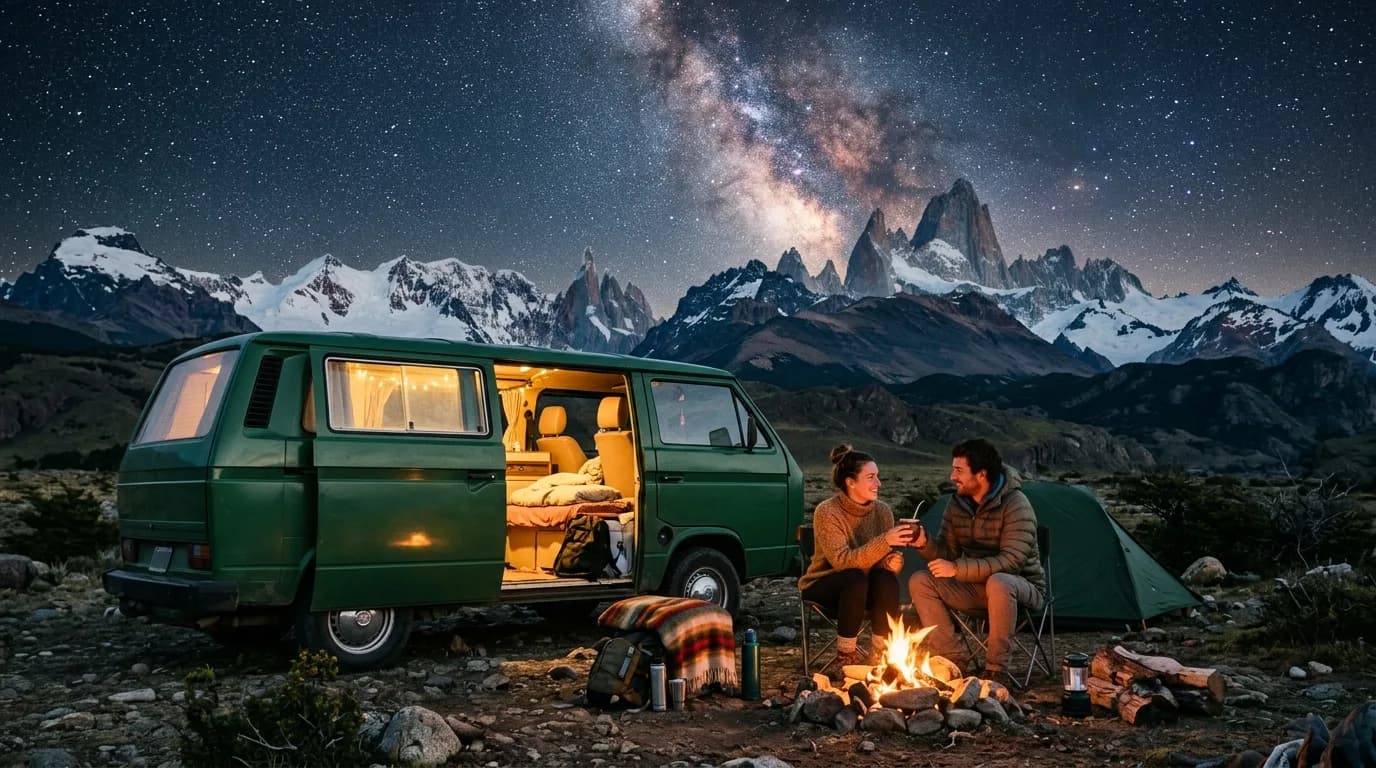
One of the best parts of a campervan trip is choosing where to wake up: a lakeshore in Patagonia, a vineyard road in Mendoza or a quiet beach in Uruguay. Finding a spot is usually easy, but each country and region has its own rules and customs. Here is how to sleep well, legally and respectfully on both sides of the Río de la Plata.
Campsites: municipal and private
Argentina has a strong camping culture, and almost every town has a camping municipal, a campsite run by the local council. They are usually cheap (approx. $5 to $15 per person per night), simple and full of local families in summer. Private campsites cost a bit more but often have better showers, wifi, electricity and a proper parrilla for your asado.
Campsites are perfect every two or three nights to shower, fill up water, charge devices and do laundry. In January and February, popular campsites near beaches, lakes and El Chaltén can fill up, so arrive early in the afternoon.
Free camping and how to do it right
Wild or free camping is widely tolerated in rural Argentina, especially in Patagonia and the north, as long as you are discreet and respectful. Good free spots are often riverbanks, viewpoints, gravel areas off quiet roads, or YPF stations on long routes, where many travellers stop for a night with permission.
In cities and touristy towns, it is different: many municipalities prohibit sleeping in vehicles on the street. If you see a no camping sign (prohibido acampar), respect it and move on.
- ●Arrive late, leave early and keep a low profile
- ●Do not set up tables, awnings or chairs where camping is not allowed
- ●Ask permission if you are near houses, farms or businesses
- ●Never park on private land or blocking a gate
- ●Stay away from riverbeds that can flood after rain
Apps that make it easy
iOverlander is the go-to app in South America, with thousands of campsites, free spots, water points and mechanics added by other travellers. Park4Night is also useful, especially in popular areas. Read the most recent reviews: spots change, and a place that was fine two years ago might now be closed or fenced off.
Download offline maps as well (Google Maps or Maps.me), because large parts of Patagonia and the north have no mobile signal.
National parks
In Argentina's national parks, you can only camp in designated campsites, either organised (with services and a fee) or free (agrestes, basic and sometimes without water). Wild camping outside these areas is not allowed, and fires are often restricted or totally banned because of wildfire risk. Check the rules at the park entrance or with the rangers (guardaparques), who are usually very helpful.
Uruguay: know the coastal rules
Uruguay is relaxed and safe, but on the coast the rules are stricter. In the department of Maldonado, which includes Punta del Este, José Ignacio and much of the busy coastline, overnighting in vehicles outside campsites is restricted, and you can be fined or asked to move. Use campsites here; there are good ones along the coast.
Cabo Polonio is a special case: it is a protected area with no road access for private vehicles. You leave your van at the entrance parking on Route 10 and take the authorised 4x4 trucks across the dunes. Plan to sleep in a hostel or cabin in Cabo Polonio, or return to a campsite nearby. Rules can change, so check locally before you go.
Water, toilets, safety and leave no trace
Fill your water tank at campsites, fuel stations or public taps whenever you can, and use campsite or station toilets. Never empty grey water or anything else onto the ground near rivers or lakes. Take all your rubbish with you until you find a proper bin; in remote areas there is often no collection at all.
For safety, trust your instincts: if a place feels wrong, leave. Lock the van at night, keep valuables out of sight and avoid sleeping right next to busy roads in big cities. In practice, most travellers find Argentina and Uruguay very welcoming. Ready to find your spot? Book your Mate van at least 3 weeks ahead.
Ready to go?
Book your Mate Bus at least 3 weeks ahead — free cancellation up to 21 days before pick-up.